
Masei - In Depth Summary
“These are the journeys of the children of Israel, going out of the land of Egypt with their hosts, under the hand of Moses and Aaron. Moses wrote their goings out according to their journeys, by the commandment of G‑d; and these are their journeys according to their goings out.”
The Torah goes on to recount the 42 stations from the Exodus from Egypt to the Promised Land:
1) “They journeyed from Rameses in the first month, on the fifteenth day of the first month; on the morrow after the Passover . . . and they camped in Sukkot”;
2) “They journeyed from Sukkot, and camped in Eitam, which is in the edge of the wilderness”;
3) “They journeyed from Eitam, and turned back to Pi-Hachirot, which is before Baal-Tzefon; and they camped before Migdol”;
4) “They passed through the midst of the sea into the desert, and went three days’ journey in the wilderness of Eitam, and camped in Marah”;
5) Elim (“in Elim were twelve fountains of water and seventy palm trees”);
6) The Red Sea; 7) the Sin Desert; 8) Dofkah; 9) Alush; 10) Rephidim (where they thirsted for water, had doubts about G‑d’s presence and fought Amalek);
11) The Sinai Desert (where they camped for eleven months and twenty days, received the Torah and built the Sanctuary);
12) Kivrot HaTaavah (“Graves of Lust”); 13) Chatzeirot (where Miriam spoke against Moses); 14) Ritmah (the incident of the spies); 15) Rimon Peretz; 16) Livnah; 17) Rissah; 18) Keheilatah; 19) Mount Shefer; 20) Charadah; 21) Mak’heilot; 22) Tachat; 23) Tarach; 24) Mitkah; 25) Chashmonah; 26) Moseirot; 27) Bnei Yaakan; 28) Chor Hagidgad; 29) Yotvatah; 30) Avronah; 31) Etzyon Gaver;
32) Kadesh (where Miriam died, and the incident of the “Waters of Strife” took place); 33) Hor HaHar (where Aaron died, and the Israelites were attacked by the Canaanite king of Arad); 34) Tzalmonah; 35) Punon; 36) Ovot; 37) Iyei HaAvarim (“Desolate Mounds”), on the border of Moab; 38) Divon Gad; 39) Almon Divlataimah; 40) “the Avarim Mountains before Nebo”;
41–42) “They journeyed from the Avarim Mountains, and camped in the plains of Moab by the Jordan River across from Jericho; they camped by the Jordan, from Beit HaYeshimot to Avel HaShittim in the plains of Moab.”

A Warning
“Speak to the children of Israel,” says G‑d to Moses, “and say to them:”
When you pass over the Jordan into the land of Canaan, you shall drive out all the inhabitants of the land from before you; and you shall destroy all their figured pavements, and destroy all their molten images, and devastate all their high places.
You shall dispossess the inhabitants of the land, and dwell in it; for I have given you the land to possess it . . .
But if you will not drive out the inhabitants of the land from before you, then it shall come to pass that those whom you allow to remain of them shall be as thorns in your eyes, and stings in your sides, and shall harass you in the land wherein you dwell.
The Boundries of the Land
This is the land that shall fall to you for an inheritance, the land of Canaan with its borders:
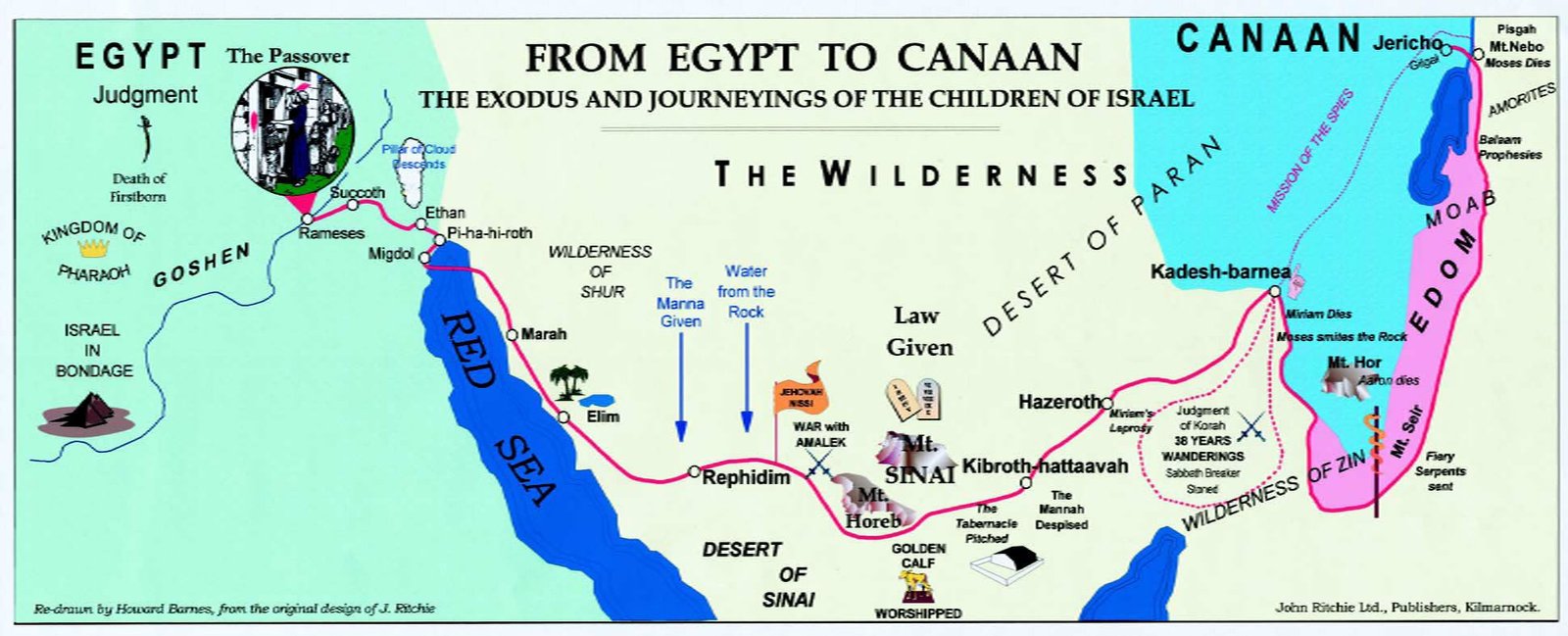
Your south border shall be the utmost coast of the Dead Sea eastward . . . to Maaleh Akrabbim . . . to Kadesh Barnea, and shall go on to Hazar Addar, and pass on to Atzmon; the border shall turn about from Atzmon to the wadi of Egypt, and its limits shall be at the Sea.
As for the western border, you shall have the Great Sea for a border; this shall be your west border.
This shall be your north border: from the Great Sea you shall mark out your frontier at Hor HaHar . . . to the entrance of Hamat . . . to Zedad . . . to Zifron, and its limits shall be at Hatzar Einan . . .
You shall point out your east border from Hatzar Einan to Shefam . . . to Rivlah . . . and shall reach the east coast of the Sea of Kinneret . . . down to the Jordan, and its limits shall be at the Dead Sea.
This shall be your land with its borders round about.
The tribe of Levi, who will not be allotted a portion of the land, should be given 48 cities in which to dwell.
The Cities of Refuge
Six cities—three on each side of the Jordan—should be set aside as havens for “one who slays a soul unawares.”
Anyone who causes the death of a fellow—intentionally or not—must find his way immediately to one of the cities of refuge, “so that the killer shall not die before he stands before the congregation in judgment.” Only there is he safe from the “redeemer of the blood”—the relative of the slain person who comes to avenge the death. For if the avenging relative kills the killer outside of a city of refuge, “he shall not be guilty of blood.”
The killer is then brought before the court. If he is convicted of intentional murder, he is executed. “The redeemer of the blood himself shall slay the murderer; where he meets him, he shall slay him.”
If he is found guilty only of causing a death through his negligence, but without intent to kill,
The congregation [of judges] shall save the slayer from the hand of the redeemer of the blood; and the congregation shall send him back to the city of his refuge . . . and he shall dwell in it until the death of the high priest, who was anointed with the holy oil.
Again, only there does the law protect him from the vengeance of the slain man’s relatives.
These laws shall be for a statute of judgment to you throughout your generations in all your dwellings:
Whoever kills any person, the murderer shall be put to death by the testimony of [two] witnesses; but one witness shall not testify against any person to cause him to die.
You shall take no ransom for the life of a murderer, who is guilty of death. . . . For blood pollutes the land; and the land cannot be cleansed of the blood that is shed therein, but by the blood of him that shed it.
You shall not defile the land which you shall inhabit, in which I dwell; for I, G‑d, dwell among the children of Israel.
Marriage Restrictions
The five daughters of Tzelafchad, whose father had died without sons, had petitioned for a share in the Land (as recounted above in the Parshah of Pinchas). Now, the leaders of their tribe, Manasseh, approached Moses with a petition of their own. If any of these women will marry someone from another tribe, they argued, this would mean that their sons, who will inherit their land, will likewise be of another tribe. The result would be that “their portion . . . shall be added to the inheritance of the tribe to which they are joined, and the lot of our inheritance will be diminished.”
The following law is therefore decreed by Moses, in the name of G‑d:
Any daughter who possesses an inheritance in any tribe of the children of Israel, shall marry a man of the family of the tribe of her father . . . So that the inheritance shall not remove from one tribe to another tribe; but every one of the tribes of the children of Israel shall keep himself to his own inheritance.
“These are the commandments and the judgments,” concludes the Parshah of Massei and the Book of Numbers, “which G‑d commanded by the hand of Moses to the children of Israel, in the plains of Moab by the Jordan near Jericho.”